
The Building Blocks of Gematria in the English Language

Base Four Gematria (Ordinal)

Simple English Gematria, also referred to as the Ordinal method, is the easiest to understand. Each letter is numbered 1 through 26 relative to its position in the alphabetic order (all charts can be clicked for a larger image):
The Reverse cipher is just as elementary – the alphabet is flipped backwards so that Z = 1, Y = 2, X = 3, all the way through A = 26.
Reverse is of particular importance in the 26-letter English alphabet, as the reduced numerology of a value in either cipher can be used to determine the reduced numerology of the same phrase in the opposite method.
For instance, let’s take the 74 gematria in Ordinal for Simple, English, and Gematria as shown above. 74 has reduced numerology of 2, which is calculated by adding 7 + 4 = 11, and then adding the resulting digits 1 + 1 = 2. This also happens to be the simplest equation in Mathematics.

All we have to do to figure out the reduced numerology of these words in Reverse is to subtract the final result 2 from the number 9, which of course gives us a difference of 7.

8 + 8 = 16 | 1 + 6 = 7
1 + 1 + 5 = 7
1 + 4 + 2 = 7
If the reduced numerology of a phrase in either Ordinal or Reverse is 9, then that means it will be 9 for both. Writing out Letters, The Moon and New Moon is a perfect example of this.

9 + 0 = 9
9 + 9 = 18 | 1 + 8 = 9
You may notice that while these three words have matching Ordinal and Reverse gematria, the words Simple, English, and Gematria all have different Reverse sums, despite all equaling 74 in Ordinal.
This is because Letters, The Moon, and New Moon are all made up of seven letters, while each of the other words has a different number of letters. If two matching phrases do have a different number of letters, this means the opposite methods will always be a multiple of 27 apart. This is rather neat, as 2 + 7 gives us our magic number of 9.
88 + 27 = 115 | 115 + 27 = 142
Reduction / Reverse
Let’s take the concept of reduced numerology a step further. Rather than reducing the Ordinal or Reverse gematria of a phrase, what if we were to reduced every double-digit number in the alphabet prior to even adding it to the equation?

Under this lens, we find that while words with the same Ordinal gematria will often also have the same Reduction gematria, this is usually not the case.

However, these numbers are still somewhat similar in that they retain the same reduced numerology as they had in Ordinal.
2 + 9 = 11
3 + 8 = 11
1 + 1 = 2
Likewise, these words will also retain their reduced numerology of 7 in the Reverse Reduction cipher.

3 + 4 = 7
5 + 2 = 7
An astute observer may see that while English and Gematria are the two matches in Reduction, it’s only Simple and English that match in Reverse Reduction.
It is generally considered relevant if two phrases share at least one value in any of the Base Four ciphers. I will sometimes call it a double match when they share two values, or a Supermatch if they have three. A match across all four ciphers, regardless of whether they’re found in the same ciphers, is very rare and is called a Perfect Supermatch.
Extended (Denary) Gematria
Having a clear understanding of reduced numerology will also make this next part straightforward.
While the Ordinal and Reduction methods produce mostly 2- and 3-digit results, the Standard and Latin ciphers typically generate 3- or 4-digit results, with longer phrases going even higher:
Much like the Reduction chart of 1-9, 1-9, and 1-8, the Standard and Latin charts travel from 1-9, 10-90, and 100-800. For lack of a better term, I call this amplified numerology as opposed to reduced numerology.
These ciphers may look more familiar to those accustomed to classic Hebrew Gematria and Greek Isopsephy:
The Latin / Agrippa’s Key cipher (also referred to elsewhere as Jewish gematria) is the only method I regularly use in my decodes that is not based on the modern English alphabetic order, but also happens to be the one I consider the most significant.
Knowledge of this cipher can be traced back to Heinrich Cornelius Agrippa, who revealed it in his 1531 publishing Three Books of Occult Philosophy. It is based on the 23-letter classical Latin alphabet, with the newer characters J, V, and W placed at the end. The letter that once occupied 800 is now extinct.
As Standard and Latin yield much larger sums in gematria, matches in or across them are considered very relevant, as they are much less likely to occur. However, it’s not as unlikely as the large numbers would suggest, because values in Standard and Latin will always end with the same digit.
Phrases with at least the same reduced numerology in the Base Four may have the same Standard gematria, but it is very uncommon. It is even less common for this to occur in Latin, because after the 9th letter, the reduced numerology for the same character changes. Let’s look at the words from above for an example.

2+5+4 = 11
2+0+9 = 11
3+5+3 = 11
1+1 = 2
Although we can know for sure that the Standard values will all reduce to 2, this does not necessarily mean the value in Latin will as well.
2+1+4 = 7
1+7+9 = 17
2+3+3 = 8
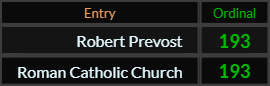
You may quickly realize how infrequently matches across these large-number methods are, but they do occur. For instance, take a look at the finely-crafted name of Robert Francis Prevost, the first American to ever become pope of the Roman Catholic Church.

Sumerian Gematria
As gematria is just part of a larger kabbalistic study, just as much (if not more) significance is placed in the passage of Time, which regulates the speed of Light.

Credit for modern timekeeping is levied towards the ancient Mesopotamian Sumerians, who invented the sexagesimal system we still use on our clocks to this day. 60 seconds in one minute, and 60 minutes in one hour. The first multiple of 6 is 12, and we have 12 hours on a standard clock and 12 months in a year.
6 is much like its counterpart 9 in the way it circles back to itself. The Sumerian cipher, which is said to be the one that reveals the Number of the Beast, simply multiples the Ordinal and Reverse ciphers by 6:

Is this why the first Macintosh Computer was sold for $666.66?


6 + 6 = 12

Satanic Gematria
666 isn’t just the Book of Revelation’s Number of the Beast. It’s also a number representative of the entire Sun-Moon-Earth system.
Therefore, it’s appropriate for another cipher to be centered around this “evil” number – Satanic gematria:
Incredibly, Satanic gematria has gematria of 666 in Satanic.

666 is the 36th Triangular number
The cipher begins with A = 36
It ends with Z = 61
61 is the 18th Prime number
18 is 6 + 6 + 6
Capital Letters
The Ordinal and Reverse ciphers can also be amended based on the usage of capital letters. These are a relatively recent in human history, and did not exist in the aforementioned ancient languages.
There are two generally-accepted methods that take capital letters into account, with the first being Capitals Added, which adds 26 to the Ordinal value for every capital letter:
The second, which is also known as the Classroom cipher, is called Capitals Mixed, which essentially multiples the Ordinal value by 2 and then subtracts 1 for each capital letter:
These ciphers and rules also apply to Reverse through these flipped charts called Reverse Caps Added and Reverse Caps Mixed:
Mathematical Ciphers
The Prime, Trigonal, and Squares ciphers are all very basic. Simply use the associated Prime, Triangular, and Square number based on the letter’s Ordinal position to determine the new value.

Although you will rarely see me refer to any of these, there is some relevance to their Reverse counterparts.

A similar, yet notably different cipher is Fibonacci.

This is what I call a Folded cipher – one that mirrors itself from the middle of the alphabet.
If we were to assign the letter Z with the 26th Fibonacci number, it would be worth 121,393. This would yield unreasonably large gematria values that are highly unlikely to contain any significant matches, which is one reason I believe it’s more pertinent to stop at the 13th Fibonacci number. After all, 13 is the 6th Prime number, and is itself a Fibonacci number.
English Qaballa
In 1904, occultist Aleister Crowley published The Book of the Law, which reveals a special variation of the alphabetic order.
The English Qaballa (formerly the ALW Cipher) is the first and simplest to understand:
Counting begins at A, the first letter of the alphabet, which receives a 1. You must then travel forward 11 letters in the alphabet to arrive at the next letter, which is L, and 11 more to get to W.
You can’t count forward 11 from W. Instead, you count 3 more to the letter Z, and then reset the alphabet for the remaining 8, which takes you to H. Then move forward 11 letters to S, and repeat the pattern until you reach every letter of the alphabet.
Cipher X (formerly the KFW Cipher) is directly derived from the English Qaballa:
Here, you begin at the 9th letter of the English Qaballa (K). You then move forward 9 letters to 18 (F).
Moving forward another 9 means the alphabet needs to be reset, which would normally bring us to A given the previous guidelines. However, whenever the alphabet is reset, you instead move 11 ahead, which lands you at W.
This pattern is repeated for each letter, unless the previous letter is T, E, or P, which are the last three letters of the Qaballa. In that case, you only move forward 3, which is why A succeeds T and L succeeds E.
The value of a phrase in the English Qaballa is always either the same as its Cipher X sum, or different by a multiple of 8.
The third cipher is Trigrammaton Qabalah (formerly LCH). I personally do not know if there is any pattern to its construction. Feel free to e-mail us if you happen to know something about it:
Alphanumeric Gematria
Check out the work of Luís Gonçalves, a contributor to research in the Qabalah methods above and below.

